
Three Sigma
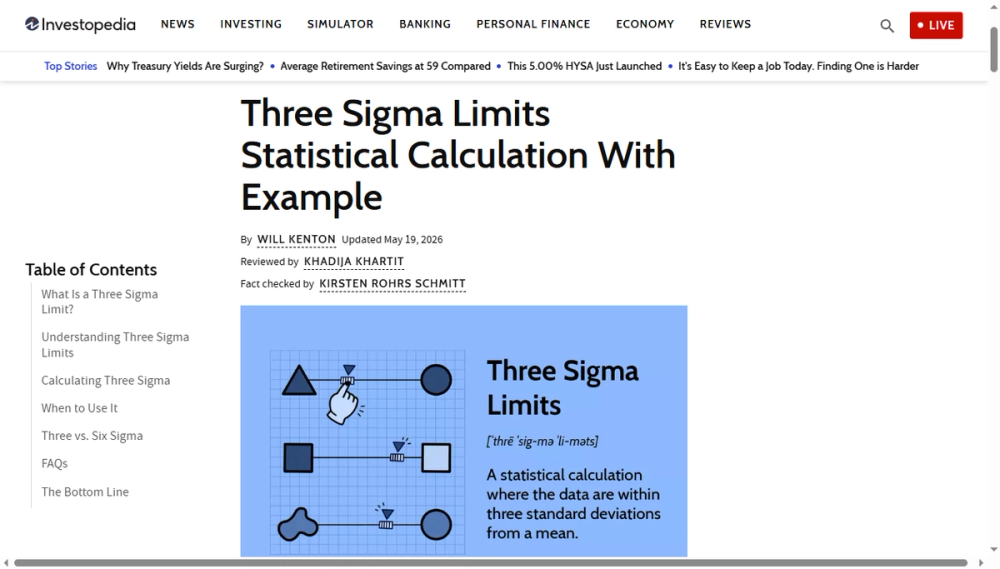
Three Sigma (3-Sigma) is a fundamental concept in statistics, manufacturing, and process engineering. It refers to the statistical rule where 99.73% of data in a normal distribution falls within three standard deviations (3σ) of the population mean.
Key Concepts
- Empirical Rule: States that 68.27%, 95.45%, and 99.73% of values lie within one, two, and three standard deviations from the mean, respectively.
- Defects Per Million: A 3-Sigma process level corresponds to approximately 2,700 defects per million opportunities (DPMO).
- Three Sigma vs. Six Sigma: Six Sigma pushes process capability further to achieve near-perfection (3.4 DPMO), whereas Three Sigma represents standard quality control baselines.
Use Cases
- Manufacturing & Quality Assurance: Setting product tolerance limits and identifying process anomalies.
- Risk & Finance: Detecting rare market movements, often called 3-sigma events.
- Operational Efficiency: Monitoring process performance using statistical process control charts.