
Gladia
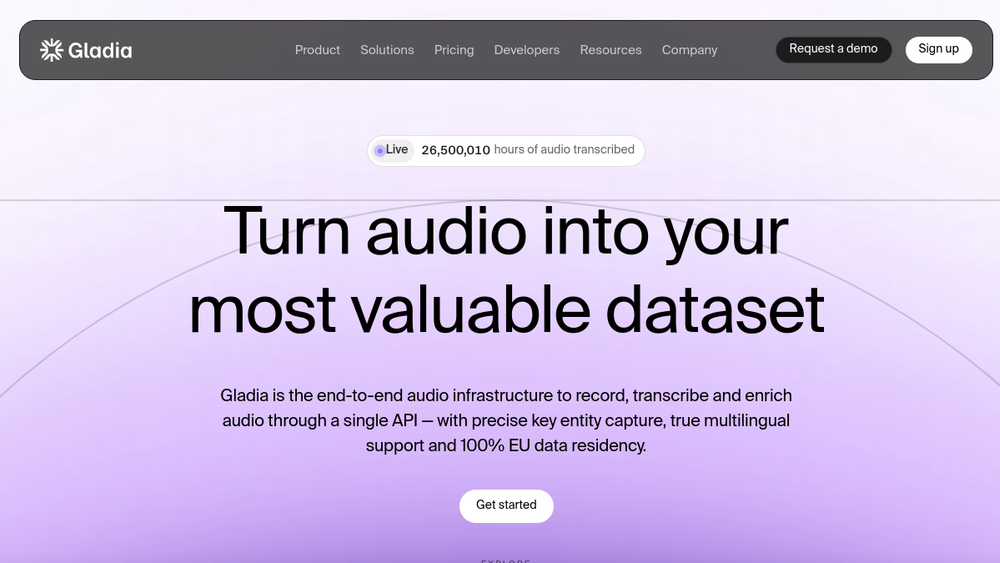
Gladia is an end-to-end AI audio infrastructure that enables developers to record, transcribe, and enrich audio through a single API. It turns spoken conversations into structured, actionable data, powering voice products and applications.
Core Features
-
High-Accuracy Transcription: Offers both real-time (streaming) and asynchronous (batch) speech-to-text capabilities with low latency. Features top accuracy on conversational audio and advanced speaker diarization.
-
Multilingual Support: Supports transcription in 100+ languages with built-in code-switching and accent resilience, making it ideal for global applications.
-
Audio Intelligence: Provides enrichment features natively within the transcription layer, including sentiment analysis, named entity recognition (NER), summarization, and custom vocabulary support.
-
Enterprise-Grade Infrastructure: SOC 2 Type II, GDPR, and HIPAA compliant with EU data residency. It includes a 99.95% uptime SLA and a data training opt-out by default.
-
Developer-First API: Features official SDKs for Python and Node.js, WebSocket streaming, and native integrations with platforms like Pipecat, LiveKit, and Twilio for rapid deployment.
Primary Use Cases
Gladia is built for teams building voice-driven products. Key use cases include:
- Meeting Assistants: Powering real-time transcription, summarization, and action item extraction for virtual meetings.
- Contact Center (CCaaS): Providing real-time agent assist, quality monitoring, and sentiment analysis for customer interactions.
- Voice Agents: Enabling low-latency, multilingual speech-to-text for conversational AI and voice bots.
- Content & Media: Automating subtitles, captions, and content indexing for audio and video platforms.